Article
Why Tiro Keeps Winning in a Crowded Market
Yuna Hong of AG1 Batch 2 on leaving VC, outlasting 100 copycats in Korea, and bringing Tiro to Japan.
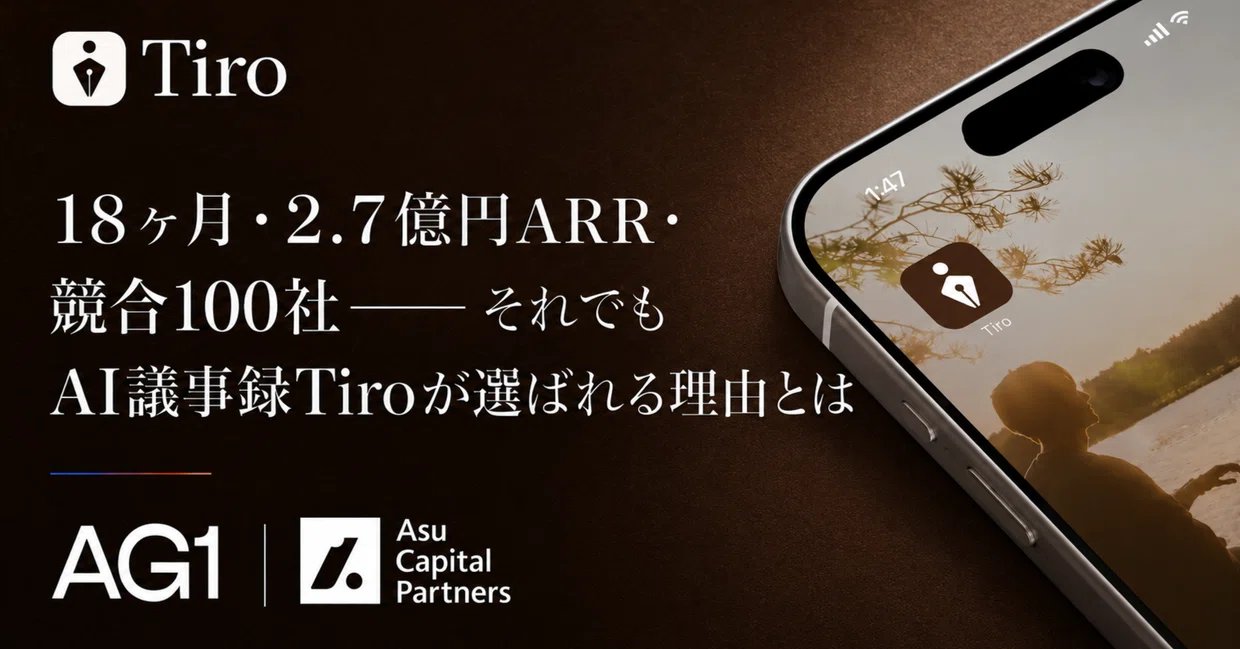
This piece was first published in Japanese by Hideo Natsume on May 27, 2026. This is an English translation. Read the original on note.
Hi everyone, it's been a while! This is Hideo Natsume from Asu Capital Partners.
It has been about half a year since my last post. This time I want to share an interview with Yuna Hong, CEO of Tiro. Tiro is one of the teams in Batch 2 of AG1, the live-in founder residency program we run at Asu Capital Partners.
I wrote a little about Tiro and Yuna on X last week. This time I wanted to give you a fuller picture of Tiro, and of Yuna herself, a founder who started out in venture capital.
More and more VCs around the world are becoming founders. So I asked Yuna a few things. Why did she leave the investor side to build a company right in the middle of the AI boom? Why did she choose real-time transcription, a market that looks like a red ocean? And after building ¥270M ($1.7M) in ARR in Korea in just a year and a half, why did she decide to focus on Japan instead, including joining AG1?
I learned a lot from this conversation, both as a VC and from watching a fast-growing Korean founder in real time. I hope you read to the end, and I'd love it if you shared it!
From student founder to VC to founder
What made you move from VC to founder?
I started my first company in 2019, while I was still a student at Seoul National University. It was in EdTech. I was 21, so education was the biggest problem right in front of me, and the market was growing at the time.
After about two years, I realized there was a big gap between the business I wanted to build and the business that actually worked. My motivation was also shifting toward solving problems that really exist. So we sold the company to an EdTech startup that was around Series B. The very next day, I joined Capstone Partners, a VC I already knew, as an intern (laughs). No break at all.
My years in VC were genuinely happy and fun. I worked hard even as an intern, and my boss told me, "You'll probably start a company again someday, so get two or three years of solid experience first." I hadn't graduated yet, so they let me keep studying while I worked.
2021, the year I formally joined Capstone, was also the peak of the Korean market. Startups I had been benchmarking saw their valuations fall to a half, even a quarter, when the bubble burst. Market momentum was terrible, and nobody could raise money.
Then in October 2022, ChatGPT launched, and the market got knocked out of shape. That distortion turned into opportunity. I couldn't sit still. I wanted to throw myself back into the rough waters of starting a company, so I began looking for ideas. While still at Capstone, I worked on side projects and brainstormed with friends, and that is how we landed on Tiro, a real-time transcription platform. I left Capstone in December 2024 and officially founded the company.
What a founder's story! You started Tiro in December 2024, when real-time transcription was already crowded and looked like a red ocean. Why build in this space?
People often ask me, "What's your competitive advantage? What's your moat?" I think about it a lot, even now, a year and a half in. A small side note: we actually launched Tiro on September 30, 2024, before we had even incorporated. Within two months, more than 100 similar products appeared in Korea alone. We were in a shared office in Seoul back then. Before I knew it, a founder I was friendly with, sitting two meters away, launched a similar product. The month after that, the team sitting across from us shipped something that looked exactly like Tiro (laughs).
Here is the part that really stung. Two of the teams that launched real-time transcription products after us got into Y Combinator on the strength of those products. That is how intense the competition was, and how much attention real-time transcription, AI meeting notes and voice AI were getting. From January to June 2025, ChatGPT, Gemini and voice AI startups all over the world kept polishing their products and going to market. Even so, we stayed in the market and kept growing. Of course, founders who got into YC have more leverage on resources, capital and talent. But what matters most is whether users love your product.
Winning in a red ocean with product and brand
Even with more than 100 copycats in Korea, there are two clear reasons we kept winning. One is the product. The other is branding and storytelling.
On the product side, accuracy matters more than anything. Building highly accurate real-time transcription AI is really hard, but compared with overseas products, especially American ones, we were stronger in Asian languages. We started by offering Korean B2B companies a free one-month PoC and encouraged their employees to use Tiro actively, for conference calls and so on. Most companies ran PoCs with several competing products at the same time, then used an internal survey afterward to decide which one to adopt. In the end, we won more than 90% of those PoCs, and many large Korean companies still use us today. (Note: Tiro's paid subscription retention is still 86%.) What struck me most was that the surveys didn't just say "it's accurate." A lot of people said "it's especially easy to use." We had always obsessed over user experience, so hearing that made me really proud of the product and the team.
The second point, and the most important one, is branding and storytelling. From launch, we focused on getting top voices involved. Through my VC network, I met VCs, well-known startup founders and AI influencers in person and turned them into fans. They then started reposting our posts and recommending the product on their own. I think that was pretty stressful for our competitors (laughs).
If I add one more thing, it's our decision-making speed. Most AI meeting-notes players chase both B2C and B2B users. We didn't think there was much demand for transcribing casual conversations, so we moved to B2B early and got enterprise security and privacy certifications in place at a very early stage.
We also shipped on every platform: web, desktop, mobile, and now even Apple Watch. For a startup, that might look like an anti-pattern, but looking back, I think every one of those decisions was right. What matters to us is understanding the market fast and staying humble. At this stage, we can't beat Anthropic or Google. The key is to spot opportunities one or two months before they do. What makes that speed possible is a small team of about ten people our own age, a size we keep on purpose. Everyone works incredibly hard, and being small and fast is our biggest weapon.
You built ¥270M in ARR in 18 months from Korea alone, and you speak great English. Why focus on Japan at this stage? Honestly, you seemed ready to do what your founder friends did: join something like YC and go after the US market.
Actually, both of the YC teams I mentioned couldn't keep up with Tiro's growth. They gave up on Korea and now focus on the US. One is still building AI meeting notes; the other pivoted into a browser business. For us, one of our best decisions was to stay focused on Asia, even though YC was a real option. In Asia, demand for real-time transcription and AI meeting notes far exceeds supply. And for Tiro, with our strength in Asian languages, Asia is our home turf.
Something else we noticed while digging deep into Korea: many of our users don't even use ChatGPT. They aren't very tech-savvy. I think that only happens when you go really deep into a single market, and it's a competitive advantage that is very hard to take away. Japan is the second-largest B2B market after the US, and it has real synergy with Korea. So I want to start by moving to Japan myself, learning the market properly, and building the product for Japanese users. (Note: Yuna has already moved to Tokyo.)
The path from VC to founder
Last week, as part of AG1, we went on a retreat in Odawara and climbed a mountain. You were always at the front, saying "I want to be number one" and "I want to build a unicorn." That stuck with me (laughs). What does being a founder mean to you?
On a practical level, it means being global and becoming a unicorn. But if you ask the deeper question of why I chose to be a founder: in your early twenties, everyone starts asking, "Why am I here? Why am I alive?" I did too. Part of me wanted to run from that question. Especially when I started working in VC, I struggled a lot trying to find meaning in society and in the world.
After a year in VC, though, the answer started to come into view. I could keep collecting a salary and stay inside a safe shell while searching for meaning in my life. Or I could jump into a world that is complex and chaotic in ways that are hard to put into words, but where I could give everything I have. At some point that choice became very clear. I chose the second one.
When I thought about what this generation wants and what young people should be doing, I realized the answer was business: using technology to make people's lives better. Making every decision in life with integrity, and trying to make people happy. That is what life means to me. Once I found that, I started this journey with my team.
Because of my VC background, I knew how complicated a business really is. You have to deliver value to users, keep the company financially healthy, deliver value to stakeholders, and finally make your own team happy. You have to face all four. It's hard, but I want to do all of it. Build a financially healthy company, make customers happy with a great product, become a unicorn, and keep the team happy too. That is what being a founder means to me.
As a former VC, you can see risks and market-selection issues that others might miss. Why still choose voice AI and real-time transcription, such a competitive space?
Right, founders from VC can see all the risks, and that's exactly why they hesitate to jump (laughs). If you look at transcription on its own, the market may well be small and competitive. But voice technology as a whole is a huge market, and in the AI era it has real potential to become the next layer of infrastructure.
When I was working on EdTech, I could always feel the ceiling of the market. I don't feel that at all now. As the market grows, more competitors show up, and it doesn't bother me at all. Even if Tiro fails, this market will definitely produce a winner. I think the opportunity here still has more than ten years to run, so our job is simply to keep solving users' problems inside this huge market.
Last question, and sorry if it sounds like an ad (laughs): how has AG1 been so far?
I'm really glad AG1 was my first step in Japan. The residence is a great environment, and above all, everything is set up so I can focus on the business. Having peers, the other residents, around me all the time is also a big support. It's been about three weeks since we started, and we've come to understand each other really deeply. We push each other to get better. Every Monday there's a feedback session with all the residents, so we stay sharp on product development and sales.
To be honest, the people here are my first friends from outside Korea. Getting to know them through AG1 is the most valuable thing I've gained, and I'm really glad I joined the program.
Thank you, Yuna! AG1 Batch 2 Demo Day is at the end of June, so we're really looking forward to it!
That's it for this interview with Yuna and Tiro! If you'd like to learn more about Tiro, please visit their website or reach out to Yuna on X.
- Tiro: tiro.ooo
- Yuna on X: @yuna_tiro